Monday, June 13, 2011
Cousins, Identical Cousins...
Well, not really. But I have been struck over the last couple of years at how much my son, Z, is like two of my cousins, Ben and Kevin. (There surnames are not Roth so I’m pretty safe using their first names.) They are the sons of my only maternal aunt who I grew up calling DeeDee. Her name is nothing like DeeDee. She became DeeDee in a convoluted set of circumstances that involved both my mother’s and my own in ability to pronounce her name correctly. My mom distorted it, it sort of stuck, and then my toddler speak distorted it even more.
The older of my aunts boys are is about eight years younger than me. I was ring-bearer at her wedding since we had no boys in the family at that time. Yes, my grandfather was thrilled by this fact. His infamous, “Baby dolls again,” remark upon the birth of my cousin Lisa—granddaughter number four—is family legend. The farm set he had purchased for his grandson, complete with barn, plastic animals and real metal John Deer tractors waited for nearly 10 years under the bed in the spare room. Of course after Lisa it was 13 or 14 years before another girl would be born in our family. Again, I digress. Because of the age difference, I felt very much the grown up around the babies that were my cousins. I helped change diapers and even babysat them when I was a bit older and they were too. Funny how perceptions change. If you ask Ben and Kevin, they’ll tell you I was a mean babysitter. If you ask my uncle’s kids, Lisa and Jeff, I was fun. Hmmmm…does that say something about me, or them?


Friday, June 10, 2011
Were things better when we were kids?

If you live in the world of Facebook, tweets or even chain emails you’ve seen something like this before:
“
Wednesday, June 8, 2011
IMHO-In my humble opinion
Rather than do full reviews one at a time, I started doing group reviews. The opinions here are just that, my opinions. I have no intention of insulting an author or trying to persuade or dissuade a reader from reading these books. That's the great thing about books. There are enough out there that everyone can find something they like.
 Shelter’s of Stone- Jean Auel
I loved the Earth’s Children series right up to The Plains of Passage. It was arguably a filler book, but in my humble opinion, it wasn’t needed. We didn’t need to retrace Jondalar’s footsteps after we’d read about his journey in detail during Valley of Horses. Shelters of was the long awaited next edition, written after Auel walked away from her writing due to a personal tragedy. That in and of itself makes me loath to point out that while her writing is still excellent, her editors and betas failed at their jobs. The book is overly long and repetitive. The song the clan sings about the origins of the earth and it’s people (and it’s one long epic poem) is repeated in near entirety at least four times. Every blade of grass and piece of rock are needlessly described in minute detail. While I loved the first three books in this series and would recommend them to anyone, I’m not sure I’ll be continuing to read it.
 Turn Coat- Jim Butcher
This was Butcher's usual good solid writing, but I only gave it three stars instead of four on Shelfari for a couple of reasons. First, the story took a long time to set up and drug a bit even with rapid fire events. They were there, quick and bloody, but just not that interesting. Secondly, Laura Raith is becoming a caricature of herself, especially in the early part of the book where we hear her tired old "ooh, I'm going to seduce you if I want to," crap. And the "I can give you want you want...freedom from the pain and responsibility," wasn't compelling, just ridiculously reminiscent of Star Trek V as Spock's brother encourages everyone to share their pain.
Finally, I would have preferred if the resolution hadn't been so damned predictable. Sticking with the Star Trek analogy, we all know it's the new guy who shows up who will be the bad guy. The "villain" was easily identifiable from the moment he showed up and Anastacia's part in what happened was also predictable. Still, the Harry Dresden series is one of my favorites period and is definitely tops in urban fantasy. If you haven’t read it, go pick up Storm Front, the first, and you won’t regret it.
 Proven Guilty- Jim Butcher
Yep, it was a two Harry Dresden sort of time the past couple of months, mostly because I have a horrible commute and the series is now on audio book read by the lovely and luscious James Marsters. Damn! I love me some Spike.
In this installment Harry is faced with the task of reconciling his role as a Warden after once being target number 1 of same group and with finding a black magic practitioner, a warlock, who is preying on people’s fears and causing psychic damage. Mix in a good deal of Unseelie and Seelie intrigue and meddling, one teenage daughter of Harry’s best friend, Michael (uber arch-angelesque good-guy who slays evil), tensions with Harry’s half brother and poor Wizard Dresden is having a really rotten couple of days.
The end did seemed to drag on for just a bit too long. The whole icky final scenes with Harry and Molly were just...well, icky. It doesn't matter what did or didn't happen, the truth is Butcher just didn't need to go there. It was more of a pandering to forbidden desires while letting Harry keep the high road. It just plain didn't need to be done. And can we stop with the final, let's all sit down and remind the reader of all the bad things still out there at the end so we can justify the need for the next installment? We love Harry. We want more stories about Harry. But we don't need the recap at the end of every novel.
Born of  Night-Sherrilyn Kenyon
When Nykyrian decides the League of Assassins that has been his whole purpose for existence has finally asked too much of him, to kill a child, he rebels and quits. Only, no one quits the League. One may commit ritual suicide, but no one walks away. Now, hiding from the League with his own band of for pay assassins, Nykyrian takes the contract to protect a dancer whose father’s political connections have plagued her life.
While I'm a fan of the author, this book was just okay. I suppose if I'd read it in its true chronological order (first, before I'd read any other Kenyon books) I'd have liked it better. It is clearly an early book from and author who had not reached her potential. The series was published many years ago and held hostage to a failing publishing house until the rights reverted back to Kenyon a couple of years ago. Polished up and reprinted, the League series was eagerly awaited by her fans, though some of us wondered if she really needed another series.
As a fan of her Dark-Hunter books, it was fun to play "spot the character". She has recycled charactesr from this series and names for her Dark Hunters: Nykyrian is a mix of Acheron and Kyrian, names such as Julien and Syn make appearances. Though they have different names, even Nick, Liza, and Styxx make appearances. It is fun for fans and will give you a Kenyon fix as you wait for the next DH book, but it is really only okay.
 A Brush With Love- Jo Barrett
This is a nice little book if you don't want to think too much. This is the second book I've read by this author and it has the same weaknesses and strengths. The characters are likable and fairly well drawn. However the plot is so trite and "convenient" that it is irritating. Why was it necessary to make the heroine's paralysis the result of PTSD? And curing it with a little tantrum and her declaring she wasn't a loser after everything else she'd endured ruined the entire story. Why can't the hero love her and have happily ever after with her still in a wheelchair? Why do we need a completely laughable and ridiculous recovery to end this book? As with her other book I read, the author writes herself into a storyline then uses a silly, hackneyed, and trite plot development to end her story.

Invincible: The Chronicles of Nick- Sherrilyn Kenyon
Yeah, it was also a two Kenyon sort of month. This book isn't great literature, but let's face it-- we don't read Kenyon for great literature. Be honest, how often do most of us really sit down to read "great literature"? It is good solid YA. The story is interesting, and the characters are well drawn and likable when they are supposed to be likable and not when they're not. There was a good deal less action in this particular installment of the series but it's still a good story.
I like this series for one main reason. It gave the fans of Kenyon's adult series back the Nick we knew and loved before she turned him dark and totally unlikable. I have become a bit worried about the effect of introducing this series on younger readers. My students are reading it too and have begun asking about the "Dark-Hunter books". Those are not appropriate for the middle school and up that this series is targeted at. Let's all just hope none of them pick up "Acheron".
As a long time fan of SK's adult Dark-Hunter series there are things about this alternate universe, or rather the universe as it exists according the the "original" Nick now known as Ambrose, that really irritate me with their cryptic nature and what it implies about well loved characters like Acheron. For example, Savitar shows up in this book and taunts Ambrose with something to the effect of Well let's ask Acheron... oh wait that's right we can't because of you. What exactly is he implying Nick/Ambrose has done to Acheron? Personally, I'd really like to smack Ambrose, but then I've wanted to slap him since Dark Side of the Moon. Kenyon has taken Ambrose/Nick's gigantic self pity party way too far and has turned him from dark, brooding and misunderstood hero to a sniveling little brat. Thank goodness this new Nick is a charming and lovable as the old Nick was.
She  Walks in Beauty- Siri Mitchell
A nice little story of the late Victorian period in New York and it's society with rules that would out do even the strictures of London's Regency period. It was an entertaining read full of the silly "misunderstandings" that often are used in the place of detailed plot development. This is an inspirational/Christian fiction that seems to be minus the Christian fiction and inspiration except toward the end when it becomes a very heavy handed addition to the plot, almost as if the writer had written a nice little historical fiction story with a character who goes to church on Sunday and was told she needed to strengthen the inspirational elements, so she tossed them all in at the end.
Not to mention the over sudsy soapbox about corsets that gets dumped on the reader. Okay, corsets bad. But the broader message that one should love and accept one’s appearance does come through well, not with the horrors of the corset being slammed about the reader’s ears, but in the simple act of Clare’s taking off the corset, curling up in her dressing gown and reading her book toward the end and her shocking declaration that she would need to be remeasured because she was not wearing the corset ever again.
Somewher e to Belong- Judith Miller
Johanna and Berta are two very different young women. Johanna is a life long resident of the Amana colony and a model of young womanly behavior. For this reason she is chosen to help newcomer, Berta, to adjust to the communal, collective, God-centered life of the Amana colony after having lived her life as the daughter of a prominent Chicago physician. And to say the spoiled and selfish Berta is not happy about her new living arrangements would be a gross understatement.
Set just a few years after the Great Fire of Chicago, this historical novel is an example of a good inspirational book. Spirituality is present, woven through the fabric of the story without seeming overbearing or in your face. The only problem I had with this story, why I didn't give it 5 stars, is that the character of Berta was thoroughly unlikable for far too long in the story. More than half-way through and I still wanted to put aside the pacifistic, loving world of Amana and slap that girl silly. Even reminding myself she was very young didn't help. Miller handled Berta's transformation well. Often in such a book there is a lightening bolt moment when the character changes radically and conveniently. Berta's transformation was slower and had it's moments of backsliding. Her world was shaken a part and then a serious event occurs that is believable as the catalyst for her change.
This is an excellent departure from the usual Amish setting of the Bonnet novel.
You  Don’t Even Know Me- Sharon G. Flake
This is a bit different than the books I usually read and review but I am such a fan of Sharon Flake that I couldn’t wait to pick it up. It's a good companion to What Am I With Out Him, which tells the stories of teenage girls and their relationships to boys in their lives. The problem is this book, despite it's cover, is not really one that can be sold to boys. As a middle school teacher, I can tell you that I may be able to convince a boy to take this book, but they would never finish it. Instead it will be read by girls.
The short stories in the anthology are really character sketches, portraits of young urban boys trying to find themselves and their path in the increasingly confusing and dangerous streets of major US cities. One shows us a boy whose obese adoptive father loves him like no one ever has, yet is a source of worry, fear and embarrassment for the youngster, We see a young man helping a new girl move into his building and discovers that she has a similar problem to him…a hot young mom. Both teens are faced with mothers who are still young and sexy and want to flaunt it, but the problem comes when the new mom on the block sets her sights on flaunting it with him. How does a young man say no to that, even when he knows it will hurt the woman’s daughter and his own mother. A unique look at what some would call a lucky break and others would call child abuse. A third young man struggles with the restrictions put on him by his police officer stepfather when he really just wants to get out on the street and hang with the other boys. But if he does, who will watch his two younger sisters? Where does his responsibility lie? To his family or to his own right to be young and have fun while he’s young.
This might be a great book for a boy’s literature circle, but you want to be prepared for the conversations to get uncomfortable.
Tuesday, June 7, 2011
Exposing the Exposition
As a writer I can tell yo u I’m definitely not an expert. But as a reading and ELA teacher I can tell you that there is a bit of science to writing a story. For example, a story has five basic sections and all must be present and must transition, one to the other, fluidly. I'm not speaking of the elements of plot, the characters, setting, conflict, complications, climax and resolution. I'm speaking of the way a story is laid out, a line to follow in fitting it together. It is the first of these elements that I'd like to address as it is often the most abused.
 u I’m definitely not an expert. But as a reading and ELA teacher I can tell you that there is a bit of science to writing a story. For example, a story has five basic sections and all must be present and must transition, one to the other, fluidly. I'm not speaking of the elements of plot, the characters, setting, conflict, complications, climax and resolution. I'm speaking of the way a story is laid out, a line to follow in fitting it together. It is the first of these elements that I'd like to address as it is often the most abused.
One of the most vital parts of a story, and one that is often botched by authors for reasons ranging from lack of skill to rushing to lack of adequate editing is the very first part. The Exposition.
The Exposition:
The exposition is the hook of a story. This is the beginning portion of a book that is supposed to allow the reader to become invested in the story. A solid exposition will pull in a reader who must know more about what will happen. The exposition is the Who, Where, When and What. The Why and the How come later.
Who
A good exposition should introduce the protagonist, antagonist and the primary characters who will act upon the story. This doesn't have to be done as a big, simplistic meet and greet and the antagonists name doesn't even have to be mentioned. But he and any characters who will be central to the plot must be present. The shadow of their presence, their power, their affect, must be present. This can be through foreshadowing, through a revelation of actions or even a hint of their involvement even if they are never identified for the reader.
Where and When
Where does this story take place? Even if your settings will change or the main characters will be transported to another place and time, there must be the over-arching image of where and when this story is going to take place. Some time travel books include a prequel that occurs in the time the character is going to or hint at the future time by something the character is interested in, an object he or she handles or sees or by the discussion of an important event or person from that time period.
What
The what is critical. We don’t need to know what and how, but your reader should have a vague notion of what the basic conflict is of your story by the time the move from the exposition to the rising action portion of the story. The writer doesn’t even have to tell the reader the truth. Misdirection can lead the reader down one path they think the writer is following only to have the true path revealed later. But the hints of the truth must be there.
Remember the Sixth Sense? Ninety-nine percent of people watched that movie with no idea what the real “problem” was that Bruce Willis’ character had to solve. Yet when this was revealed, we could all look back and go, “Duh!” There was this hint, that hint, and several more along the way. We were surprised and even blindsided. That’s good, the truth was there all the time and the writer used misdirection to fool us. However, he didn’t pull the real “problem” out of his backside at the end.
As I said, I’m not an expert and the truth about rules of writing is that the best and brightest among us break them…or seem to break them all the time. But as I tell my students, you can’t break the rules until you fully understand what they are and why they are there. Then you will understand the difference between breaking them and twisting them in a way that delights and engages your reader.
Monday, June 6, 2011
Characters who drive you crazy.
I'm reading a book right now set in the Amana Colonies. (They in themselves make for a unique and interesting setting for those tired of the usual Amish bonnet stories.) One of the two lead characters, Berta, is driving me mad. She is such a spoiled, deceitful, disrespectful girl that I want to slap her...hard. On one hand, when you are meant to dislike a character, this can be a stellar achievement for a writer. Creating a character that people so connect with and personalize that they hate them is difficult to do. More so, I think, than creating a character that people love.
Back when we were writing fanfiction together, one of my favorite authors--Jennifer Hudock--wrote a character called Perpetua who I grew to loathe. So much that when a friend issued a challenge in a writers group both Jenn and I belong to to write a story about a character you disliked, I chose not one of the usual fanfiction characters, but her Perpetua. In my story I took all my frustration out on the woman, leaving her alone and miserable while flaunting the happy ever afters of the men she had manipulated and hurt right under her nose. I think Jenn got a kick out of the fact that she'd written a character that could elicit such strong feeling from someone... at least that's what she said.
Does this mean I'm praising the author's wretched little wench, Berta? No. I'm pretty sure at some point I'm supposed to like her or sympathize with her but personally I'm not sure if I'm going to be able to stand the little brat long enough to finish the book.
Back when we were writing fanfiction together, one of my favorite authors--Jennifer Hudock--wrote a character called Perpetua who I grew to loathe. So much that when a friend issued a challenge in a writers group both Jenn and I belong to to write a story about a character you disliked, I chose not one of the usual fanfiction characters, but her Perpetua. In my story I took all my frustration out on the woman, leaving her alone and miserable while flaunting the happy ever afters of the men she had manipulated and hurt right under her nose. I think Jenn got a kick out of the fact that she'd written a character that could elicit such strong feeling from someone... at least that's what she said.
Does this mean I'm praising the author's wretched little wench, Berta? No. I'm pretty sure at some point I'm supposed to like her or sympathize with her but personally I'm not sure if I'm going to be able to stand the little brat long enough to finish the book.
Thursday, March 24, 2011
Recent Reads
I’ve finished several new books lately ranging from new releases to older books. Many of these were either books I listened to on tape because of my huge commute or Kindle downoads. Some I’ve liked, some I haven’t.
Always the B aker, Never the Bride
The story did have a fluffy little plot about a diabetic baker who meets a widower who hires her to bake at his new wedding business/hotel. Very fluffy, little development of characters and not a lot of chemistry, honestly. The book was free, you can't complain too much. But I wouldn't recommend it. There were a few significant problems that I saw. First, the editing of this book was horrible. The main character shakes her "hand" not her "head". There are repeated words, missing words and the punctuation needs some tending to. Whoever edited this did a poor job.
Secondly, the constant use of exaggerated dialect when the hero's sisters spoke was distracting and as a resident of Metro Atlanta, I can tell you even the folks born here don't speak in such a caricatured fashion. Finally, I don't mind inspirational stories, I like them in fact. But this story didn't read like an inspirational story. I more got the idea that it was a light romance the author couldn't sell anywhere else so she added in a bunch of heavy handed over the top preaching and moralizing and sold it off as an inspirational book. The minister in the story came across as not quite fitting in the story, he almost seemed pasted in. Further he was self-righteous and pushy; not the kind of character to truly reach out to people. He's constantly grabbing their hands and praying over them. Seriously. He grabs the heroine's hand at a hiking trail and starts praying over her. He corners the hero at a family dinner and starts praying over him. Not inspirational at all. No wonder the hero spends half the book trying to hide from him.
 Fools Rush In
Even for the freebie it was, this book was not worth it. I have read some weak stories in the name of free, but I couldn't finish this mess. It has too many hastily introduced characters who were flat. If only this book were about Aunt Rosa. Now there is a character. But Bella is just plain dull and so is the mealy mouthed, one-dimensional "hero" who just seems to stand around and look cute. And the horrible "misunderstanding" that brings them together? She is looking for a deejay. Calls and says she is looking for a deejay to work a wedding. His response? Sure, he'll take the job. But it turns out he's not a deejay, he's a carpenter but he thought she meant a D.J....as in his name is D.J. This doesn't say much about the author's respect for the intelligence of her readers. The writing is repetitive. She beats her readers over the head with her “cute” little twists.
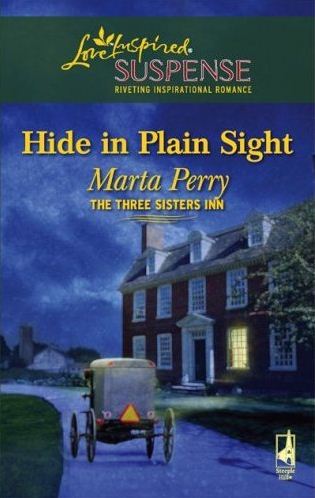 Hide in Plain Sight
I'm not an evangelical Christian. I'm probably high on their list of people going to hell, so I'm rather stunned at finding myself having to defend this book's Christian slant. But those who left the one star negative reviews over on Amazon.com seemed to have failed to read the product description that clearly identified this as one of the Amish Country/inspirational stories. I found most of the reviews were knee-jerk reactions to being upset at the book being Christian based and basically just Christian-Fiction bashing. No, the grandmother falling asleep reading the Bible wasn't "random". She was clearly established as a woman of faith. Incorporating a character's faith into the story isn't nonsense. And there was nothing sexist about it. The main character was seeking security her whole life and realized that for her that didn't mean the big corporate job. She didn't give up her career, she just decid
ed to change gears and open her own small firm in a place where she could be close to her family. How is that sexist?
That said, this doesn't have the strongest plot nor is it a great work of literature, the same can be said of 99% of books published. Most people don't read because they want to explore the themes, structures and intricacies of literature. Most people read for information or to be entertained. There were some loose ends that were never tied up. A big deal was made about the gazebo, but it never went anywhere. The ledgers
being found in the oddest places being blamed on the sister just sticking them wherever, seemed a bit lame and I expected it to go somewhere but it didn't. Still it's a nice little story and as a free read it was worth the few hours of mind candy entertainment it was.
 The Constant Princess
Historical fiction aside, Gregory plays fast and loose with the accepted facts about Katherine of Aragon. Taking an icon of determination, dedication, honesty and faith and turning her into a lying, scheming creature who is dedicated and faithful not to her God, but to the memory of her dead first husband she barely knew, destroys that which is honorable about this well loved and respected historical figure. Making things up to fill in the gaps is one thing, but damaging the reputation of Queen Katherine is not what historical fiction is.
Daughters of Joy
I enjoy reading Christian fiction, but this story doesn't read like Christian fiction, it reads like a sermon. Instead of the religion being a part of the character development and the plotting, the author seems to be hell bent, pardon the pun, on beating the reader over the head with heavy-handed sermonizing that drags down the story and makes it hard to wade through. I finished this from sheer stubbornness, but it wasn't an enjoyable book.
The book had the most laughable collection of plot elements I've ever seen. It was almost as if the writer wrote a list of all the possible elements of a prairie Christian fiction story and tried desperately to work them all in. We have the grieving widow, the grieving widower, the grieving mother who has lost her only child, the misunderstood and badly behaved little child who just needs love, the reformed alcoholic, the man abused by his father, desperate not to repeat the cycle, the reformed prostitute, the wayward wife who comes home, the cross-cultural relationship between a White man and a Native American woman, the biracial child it produces and the resulting bigotry of the community, there is the rogue who threatens the virtue of our heroine, we have the prodigal son who errs and then returns home, and the woman who the doctors have told she will die if she gets pregnant but who puts her faith in God and gets pregnant again because it was her fault her husband had an affair with the reformed prostitute (who becomes pregnant as a result) when she asked him to abstain from sex. (Anyone not clear on what the sequel that focuses on the reformed prostitute will incorporate? I hear the death bells tolling now.)
No wonder this book was such a mess.

Cowboy Trouble
Couldn't even finish this and I can stubborn my way through a lot of bad fiction. This one creeped me out. In the first half of this book, all of the male characters can best be described as creepers and potential serial killers. Who walks up to a complete stranger while wearing chaps and starts carrying her stuff in to her new house? What big-city, single woman living alone doesn't call 911 the minute cowboy dude starts touching her stuff? What hero is in his 30's and still lives with mom and dad? Then there is the town character: a guy everyone says is crazy who dresses up dead animals in tutus and baseball uniforms?
I know this was also a suspense/murder mystery, but seriously, by half way through a romance novel I shouldn't still be wondering if the hero is going to pull out a knife and slice and dice the heroine or if he has the missing girl locked in his basement. The writer makes way too much of the heroines physical attraction to the sheriff who isn't the hero. I mean a casual notice is one thing, drooling is another. On top of it all the editing and formatting are terrible. Don't bother with this one.

The Boleyn Inheritance
This is the story of three women who found their lives dramatically affected by the death of Anne Boleyn. Ann of Cleves, sent by her family to marry a man who had buried all three of his previous wives, including one he beheaded. Jane Boleyn, sister-in-law to the former Queen whose testimony sent doomed Queen Anne and Jane’s husband George Boleyn to the scaffold. And young Katherine Howard, unprepared for the position her greedy family thrust her into and who find her self the heir to Anne Boleyn’s most horrible legacy.
Gregory sticks closer to history without her usual playing fast and loose with facts. All three women are portrayed with all their faults and with their more intriguing qualities as well. Ann is the clever woman who was forged in the fire of one tyrant only to be married to another. The most clever of Henry’s wives, she is the only one to survive with Henry’s good will and brotherly affection. Katherine Howard is strangely sympathetic as Gregory reminds us she was only a child of 15 married to an old man, grossly obese and stinking of the rotting flesh of a wound that wouldn’t heal. She was full of her own self with few thoughts in her head beyond dresses and jewels. A malleable girl, not just for a King, but for those who sought to manipulate her.
Dancing in the Moonlight
This was a nice little story. I almost didn't get it after reading some of the Amazon reviews, but I've concluded those who left the nasty one star reviews are either people who don't really like this genre, have no real clue about the effects of a serious trauma on a person or people who look for some reason to leave nasty reviews. There was good character development, the author took time to show us in flashbacks how the relationship between the H/h developed over the many years of their acquaintance. The h is moody and annoying with huge chips on her shoulders but the first chip is an understandable thorn in her side from the loss of a beloved father and the need to blame someone. The second chip is perfectly understandable as well as she tries to deal with the complex emotions and trials of dealing with a physical trauma that changes her life forever. She's only five months out of the horrors of war and the devastation of losing a limb and some reviewers think it would be realistic for her to be eager to believe someone could love her and all happy sweet and nice? That's not how it works. Some people carry those wounds their entire lives.
Ignore the negative reviews at Amazon and definitely go for this one. The characters are strong and will provoke a reaction from you. Even the secondary characters are well developed and the plot is well formulated. The only reason I rate this higher was that the plot did spend a bit too much time with them actually working on the ranch jobs...then they did more ranch jobs...then they did more ranch jobs...and neither is a rancher.
Sunday, February 20, 2011
Recent Reads
I’ve finished several new books lately ranging from new releases to older books, from young adult to adult. Some I’ve liked, some I haven’t.
Gob lin Market
Jennifer Hudock
I had the pleasure of reading this book as it was being written and it was one of those you looked forward to the next chapter being completed because the characters were so engaging. The story is strong, but characterization is one of this author’s strongest skills. In the years I’ve been reading Jennifer Hudock’s work she has made me love characters, ache for them, cry for them and absolutely loathe them. One of her prior characters actually led me to have an overwhelming urge to slap the woman. The characters in Goblin Market are full, rich, relatable, and connectable. This one is highly recommended and is available from amazon.com for the Kindle and from Smashwords.com for other ereaders.
Blue Pa radise
Anny Cook
Another trip to Mystic Valley is always a good thing. The heroine’s name was a bit unsettling at first, it almost seemed as if it would fit better with Cook’s Carnal Camelot series of stories which are absolutely hilarious and very irreverent. This is the story of one of the invaders to Mystic Valley that appear in the prior book finds herself in the sites as a potential mate of two of Mystic Valley’s handsome blue warriors.
White N ights
ights
Jim Butcher
Another in the Dresden Files series of books, this one pits Harry Dresden against someone who is slowly picking off all of the magic practitioners in Chicago. Not full-fledged Wizards, the practitioners don’t have the protective skills needed to fight off the darker elements of the magical world. Worst of all for Harry, all signs point to the killer being his half-brother Thomas, the White Court vampire/incubus. This is much better than Blood Rites and Dead Beat before it. Butcher's hero has a whip snap sharp sense of humor and a tendency to make things around him explode, burst into flames
Th e Hunger Games
Suzanne Collins
This is an insanely popular YA book at the moment but after reading it I have serious concerns about the audience I often see with it. This book is not for the younger end of YA. Middle schoolers and tweens are not an appropriate audience for this book. The premise and the message are more complex than students that age can understand. The irony of using a book with horrific, and no I’m not over stating that, violence to try to show the dangers of desensitization to violence is not a subtlety that a 12-13 year old is going to get. The violence is truly extreme. A group of teenagers (ages 12-17) are pitted against each other in a gladiator type situation and must fight until only one remains alive. These children hack and slice and bludgeon each other, killing is brutal, up-close and personal and most take pleasure in the destruction they are inflicting. One girl plans to cut up the heroine slowly with a knife. The last opponent the “heroine” faces is slowly eaten alive over several hours by a group of wolf like creatures with the eyes and features of the children that have already been killed until the girl finally shoots him through the head with an arrow to put him out of his misery.
I Am Number Four
Pittacus Lore
The author’s name is a pseudonym to stage the book as if it is being written by one of the elders of the long dead planet of Lorien. The story has nine elite children who will grow up to have special gifts and talents, each with a guardian (not a parent) who are sent to Earth as the evil Mogadorians attack and destroy all life on their planet. Charmed to protect them, as long as they remain apart from one another, they can only be killed in a predetermined number. As the book opens, 1-3 are dead and the hunt for 4 is underway. Not a great story, but not bad. Slow moving for the most of the first portion of the book, the real problem is that the main characters, #4—or John as he’s now known, is what romance writers refer to as TSTL. Too Stupid To Live. Time after time he does things that guarantee he, and everyone els around him, will die.
 The Other Queen
Philippa Gregory
This was an interesting take on the story of Mary, Queen of Scots. For once, she’s not shown as the inane innocent who is victimized by those around her, but as a woman very much fighting to control her life, even when her actions will eventually lead to her death. It also tells the story of Elizabeth of Hardwick, herself a force of nature and a survivor who was able to navigate the treachery of Elizabethan England and the power of William Cecil. Gregory shows a Mary who wasn’t innocent. Claiming evidence from documents she’d examined, Gregory claims that Mary was an active participant in the attempts to free her and the plots against Elizabeth I.
Subscribe to:
Posts (Atom)